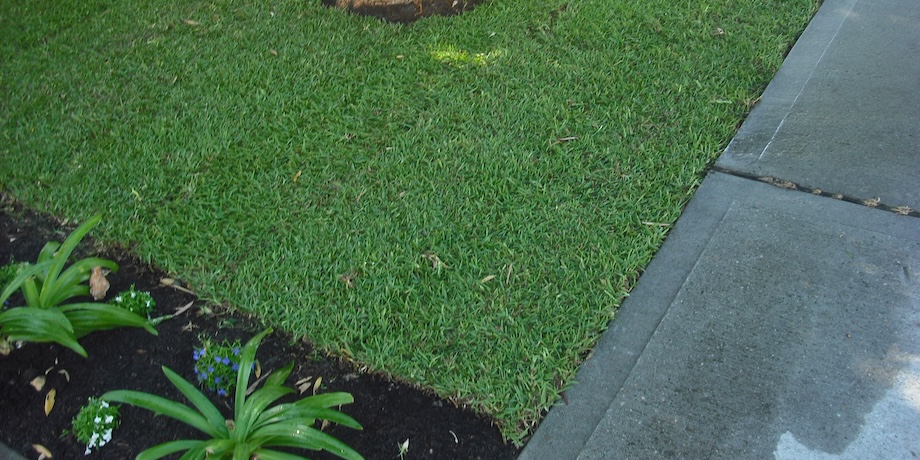
New roll on lawns will require a little extra care when we first begin their regular lawn mowing services, and they may take a few months to settle in before we can start treating them the same as other lawns.
New Turf Must Be Rooted
New roll on turf needs to have its roots into the soil before the first lawn mowing is done. We should be able to go around to the corners of the turf rolls and try to lift them up. If we can lift the turf up and away from the soil then we cannot mow the lawn yet. Waiting another two weeks before testing might be ideal.
Once we can grab that corner of roll on turf and try to lift it and if it does not move, then we can do our first lawn mowing.
First Lawn Mowing Of New Turf
The first lawn mowing will be extremely gentle, with only a light trim off the top of the grass, at very high mowing heights, just short enough that we remove just a little grass and leave the new lawn looking a little neater.
We want to be very gentle with lawn edging and line trimming, each practice can grab and pull out chunks of new turf with ease.
Next Lawn Mowings
We want to retain that same higher lawn mowing height for the first few mows. Being ever so gentle, keeping the lawn looking neat and trim as it continues to establish its root system and adapts to its new growing environment.
When new turf rolls come from the turf farm they are usually soaked in powerful amounts of fertiliser. This fertiliser combined with the increased watering for new turf will almost guarantee that all new lawns grow at very rapid speed.
It is because of this unnatural rapid growth rate of the new lawn that the lawn mowing must match that same growth rate, the only real way we can do this is to mow at higher heights during this establishment phase for the new lawn.
We continue this method of lawn mowing for as long as the fertiliser and extra water is powering this excessive speed of growth.
When To Lower Lawn Mowing Heights
We as lawn mowing contractors should know when the new lawn is telling us to lower mowing heights, just as we should know at what height all other lawns are telling us to cut them at. This knowledge comes with experience.
By whatever amount of time has passed between when the lawn was laid, and for however long the lawn kept up its rapid growth, we should start noticing changes in how the lawn is growing and presenting itself.
The lawn is now not growing so fast, it is not growing so high between cuts, there is less sponginess underfoot, the lawn is now finding its natural height at which it wants to live, this is what we should be picking up on and seeing and adjusting to.
We should see that now that the lawn is sitting and growing lower, with much less of that long green leaf, we can then start lowering the lawn mowing height.
At first we might try two notches lower on the lawn mower.
This might work out perfect and give a nice clean cut, or maybe it was just a little low so that we remember for next time to increase the mowing height by a notch for a bit longer. Or we might find that we can go an extra notch lower and still get a nice finish to the lawn mowing.
Just be aware and be careful that this is still a new roll on lawn. The turf rolls underneath can still be sitting uneven, the thatch layer can still be loose and springy, and the lawn is still very susceptible to damage from lawn mowing if we mow the lawn too low too soon. In such a case we might scalp the lawn and if the weather is hot the lawn could become sunburnt or even killed in such areas where we might have scalped the lawn.
Over more time we should feel the lawn underfoot is becoming more even, we should see in the lawn mowing that the lawn is cutting more evenly too, and we might see that some parts of the lawn are not growing as high as our lawn mowing heights in-between services, These are all indicators that we can safely lower lawn mowing heights for new lawns until we reach our preferred cutting height for whatever the grass type is in conjunction with its immediate environment and however well the lawn is performing at its specific location.
And that’s it.
Wait until the new lawn is established enough, cut high for as long as the fertiliser is speeding the lawn growth, then carefully begin to lower the lawn mowing height as the growth rates of the grass slows, then when the lawn finally shows us that it is now normally growing below our current lawn mowing heights we can then lower the mowing height again.
all articles and images are © copyright
thelawnmowingman.com